


MYCOPLASMAS: POLYMORPHIC BACTERIA WITH OPPORTUNISTIC IMPLICATION | ||
| ||
|
MODE OF TRANSMISSION | ||||||
|
CLINICAL SIGNS: WHEN TO SUSPECT A MYCOPLASMA FELIS INFECTION? | ||||||
M. Felis is generally associated with infections of the upper airways, although it may occasionally affect the lower respiratory tract. Signs of upper respiratory tract infections may include: | ||||||
| ||||||
In rare cases, cats may have difficulty breathing. Very young, very old and immunocompromised cats are more likely to develop severe disease and eventually die, usually due to secondary infections (e.g. causing pneumonia), anorexia (fatty liver) and dehydration5. Infections of the lower respiratory tract can cause coughing, lethargy, anorexia, tachypnoea or dyspnoea, nasal discharge and pyrexia 6 7. | ||||||
Since the first isolation and identification of M. felis by Cole et al (1967)8, M. felis has also been described as an agent potentially implicated in various syndromes (chronic rhinosinusitis, ulcerative keratitis...)9 10. |
A mycoplasma infection may be suspected in cats with upper respiratory tract infections. It should also be considered in those suffering from chronic respiratory diseases, such as asthma and chronic bronchitis. Additionally, it may affect cats that show no improvement despite treatment with medications targeting cell wall synthesis. These treatments are ineffective against mycoplasmas, as they lack a cell wall.
Veir et al. (2008)¹¹ suggested collecting samples from the nasal and pharyngeal sites of cats with upper respiratory tract infections. Lee-Fowler and Reinero (2014)¹² recommended endotracheal or bronchoalveolar lavages for sampling the lower respiratory tract in felines.
M. felis can also be detected from ocular swabs in cats with conjunctivitis¹³. M. felis can be detected by cytology, culture, or genetic amplification.
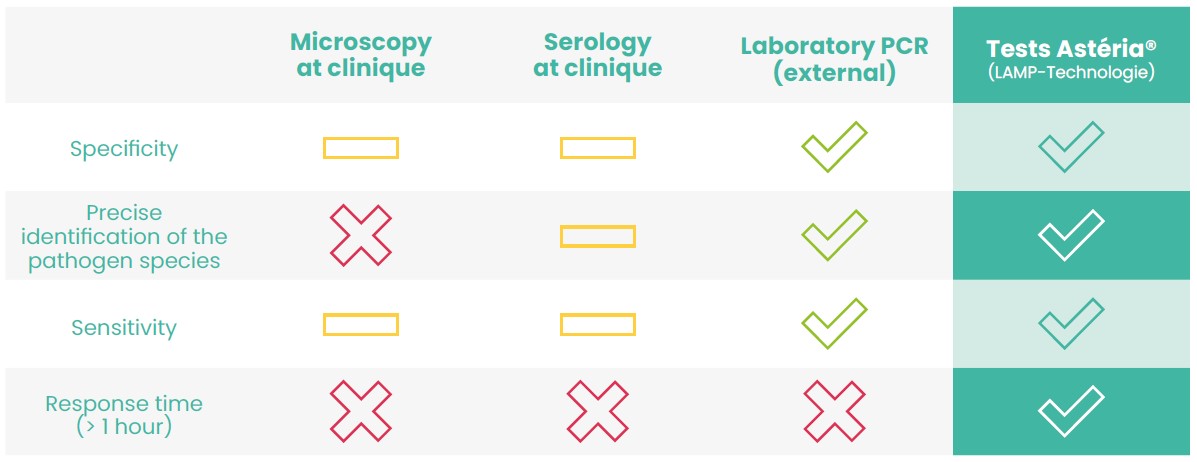
 | Cytology provides important information about inflammatory reactions and/ or concomitant infections. However, mycoplasmas can be difficult to visualise by coloration, so this technique has low sensitivity and specificity. |
 | Isolation and culture are not systematically carried out, as a specific medium is required and mycoplasmas do not survive well outside the host. In addition, the culture may be negative as a result of bad handling, excessive transport time or collection errors. As a result, visualisation of mycoplasma can be complex and error-prone due to possible confusion with artefacts. |
 | Gene amplification is a preferred option as it offers high sensitivity as well as simple and rapid mycoplasma species identification. However, as reported by Reed et al (2012)14, if the organism is not cultured and only DNA is detected, the possibility of commensal contamination should be considered due to the higher sensitivity of gene amplification compared to culture. |
Gene amplification is useful for interpreting positive results in clinical scenarios such as: On conjunctival cells (in cases of conjunctivitis), On bronchoalveolar lavage samples (when there are signs of lower respiratory tract involvement), Or on lung samples from deceased cats. Conversely, in cats with no clinical signs, M. felis can be detected through gene amplification in oropharyngeal cells and, less frequently, in conjunctival cells. |  |
TREATMENT | |||||||||
Antibiotic treatment is commonly used to treat respiratory mycoplasma infections. Doxycycline is a good first-line agent because it is well tolerated by cats and has a relatively narrow spectrum15. Oxytetracycline or chlorotetracycline ophthalmic ointment can also be used to complement topical treatment. Macrolides (azithromycin), lincosamides (clindamycin) and fluoroquinolones (marbofloxacin or pradofloxacin) can be used as second-line agents16 3. As mycoplasmas do not have a cell wall, ß-lactam antibiotics (such as penicillin) are not effective12. The length of treatment required is difficult to assess and will depend on the evolution of the clinical symptoms during treatment. Clinical signs usually disappear within a week, but chronic infections may prevent complete elimination of mycoplasma17. | |||||||||
|
WHAT THE ENALEES MYCOPLASMA FELIS TEST DOES | |||||
| |||||
Enalees has expanded its range of products to include the Mycoplasma felis test for a more comprehensive diagnosis of feline respiratory infections. The Coryza Panel, already available and allowing the detection of FHV, FCV and Chlamydia felis, is also available in a new offer named Feline Respiratory Panel allowing the detection of the pathogens of the Coryza Panel plus Mycoplasma felis. |
Bibliography

Strangles, an age-old infectious disease mainly affecting equines, represents a major challenge for equine veterinary professionals. This disease, caused by Streptococcus equi subspecies equi, an obli...

MANAGEMENT OF ANIMAL WELFARE AND APPROPRIATE TREATMENT AT Oniris...

Enalees and AB ANALITICA Announce New Partnership to Advance Animal Health in ItalyJuly 25, 2024 – Enalees, a leading biotech company in veterinary diagnostics, is excited to announce a strategi...

Enalees Showcases Innovative LAMP Technology at AAEP Annual ConventionDecember 7th-11th, 2024 • Orlando (Florida) • Booth 1990We’re thrilled to announce our first participation at the ...
Feline CoronavirusFeline coronaviruses (FCoV) are frequent in feline populations, particularly in community settings. Although the majority of infections are benign, around 5% of infected cats develop...